
Openfor.co
# The Distribution Problem: Building Is Cheap. Getting Seen Is Not.
Erdinc · 21 September 2026 · 7 min read
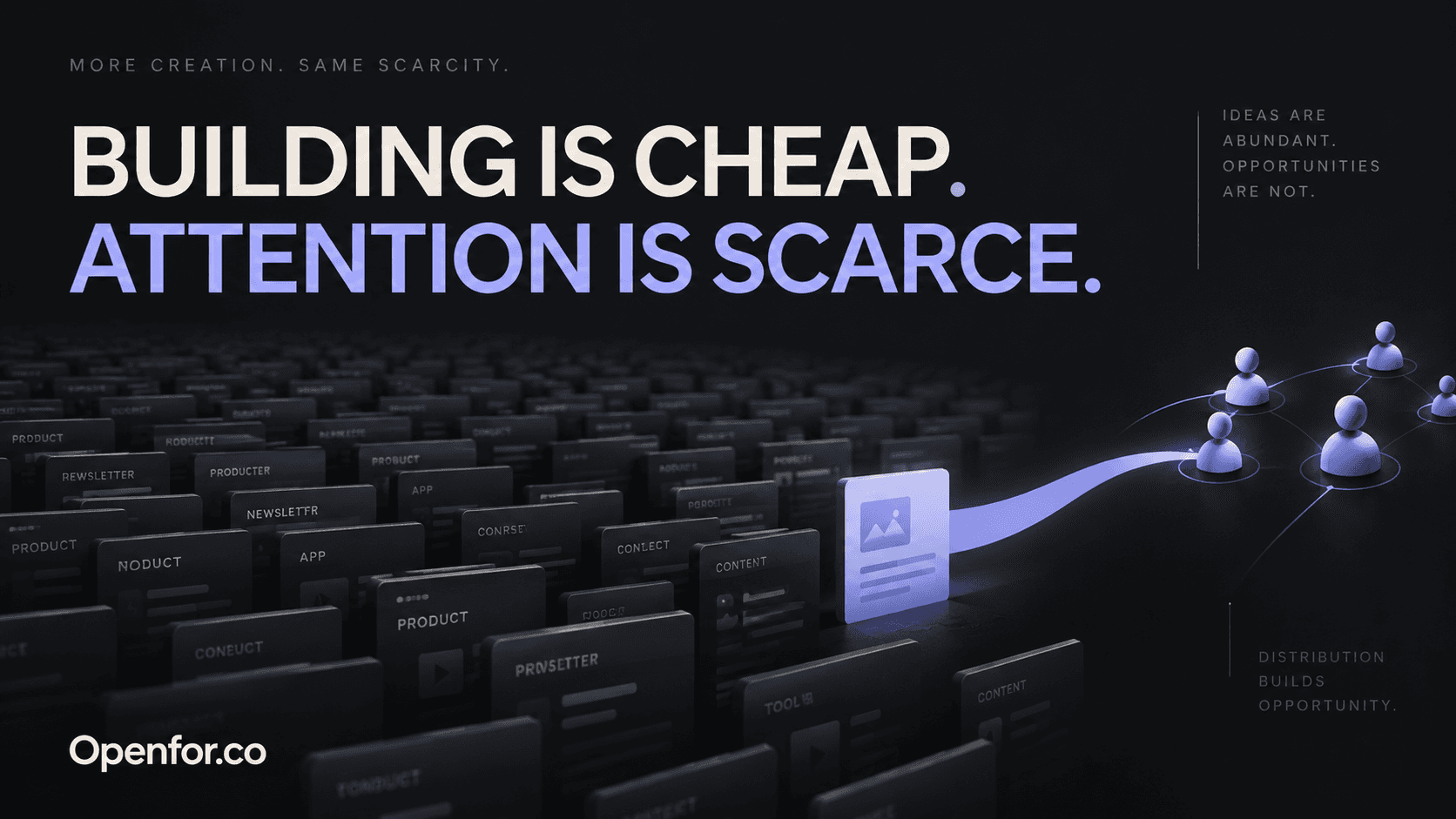
The Distribution Problem: Building Is Cheap. Getting Seen Is Not.
AI has dramatically reduced the cost of creating. It has not reduced the cost of earning attention, trust, relationships and opportunities.
Ten years ago, building was the expensive part.
You needed developers to build software. Designers to make it look professional. Writers to produce content. Researchers to gather information. Agencies to run campaigns. Consultants to create strategy.
Even a relatively simple idea could require months of work and a meaningful amount of capital before anyone outside your team could see it.
That world is disappearing.
Today, one capable person with the right AI tools can research a market, create a landing page, prototype a product, write a sales sequence, produce a presentation, generate content and test an idea in days.
That is an extraordinary shift.
But it creates a strange new problem.
When everyone can build, building itself becomes less of an advantage.
The scarce resource is moving somewhere else.
It is moving to distribution.
The bottleneck has changed
For a long time, entrepreneurship was constrained by production.
Could you build the product?
Could you afford the people?
Could you access the technology?
Could you create something professional enough to compete?
AI is steadily removing those barriers.
That doesn't mean building something good is trivial. It isn't. But the minimum cost of turning an idea into something tangible has fallen dramatically.
The result is predictable: there will be more products, more companies, more content, more offers, more newsletters, more consultants, more creators and more people trying to build businesses around what they know.
Creation becomes abundant.
Attention does not.
There are still only so many hours in a customer's day. Only so many companies an investor can seriously examine. Only so many people someone can follow, trust, buy from, recommend or introduce.
This is why we think one of the most important entrepreneurial questions is changing.
It used to be:
Can you build it?
Increasingly, it is:
Can the right people discover it, understand it, trust it and do something about it?
That is the distribution problem.
Distribution is bigger than marketing
When people hear "distribution," they often think about advertising, social-media followers or getting more website traffic.
We mean something broader.
Distribution is your ability to repeatedly get the right work in front of the right people, build enough trust for a conversation to happen, and turn those conversations into opportunities.
Those opportunities may be customers.
But they could also be partnerships, introductions, investors, collaborators, media coverage, speaking invitations, referrals or simply the next person who opens an important door.
Seen this way, distribution isn't a department that comes after product development.
It is part of how progress happens.
Imagine two equally capable founders.
Both build strong products.
One spends twelve months quietly improving the product before beginning to tell people about it.
The other starts talking to customers immediately. She shares what she is learning. She develops relationships in the industry. She publishes useful ideas. She asks for introductions. She attends conversations where her future customers already spend time. She collaborates with people who already have audiences.
Twelve months later, they haven't merely accumulated different numbers of followers.
They have accumulated different amounts of market knowledge, trust, relationships and opportunity.
That gap compounds.
Visibility is not vanity
Founders sometimes resist visibility because they associate it with becoming an influencer.
That isn't what we mean either.
You don't need to post your breakfast.
You don't need 100,000 followers.
You don't need to turn every thought into content.
You need the relevant people to know that you exist and understand why you might matter to them.
That distinction is important.
A brilliant product that nobody encounters has no customers.
Deep expertise that nobody can discover generates few opportunities.
A founder with no visible track record asks strangers to make a much larger leap of faith.
A partnership that is never proposed never happens.
Visibility isn't the destination.
It is the entrance.
We think of the process as an Opportunity Loop:
Visible → Understood → Trusted → Conversation → Opportunity → Proof → More Visibility
Being seen creates a chance to be understood.
Being understood creates the possibility of trust.
Trust creates conversations.
Some conversations create opportunities.
Those opportunities produce results, relationships and proof.
And proof makes the next round of visibility more powerful.
The important part is that this is a loop, not a campaign.
Stop building in private
There is an old pattern that still shapes how many entrepreneurs work:
Build.
Improve.
Improve again.
Perfect it.
Launch.
Then figure out how to get people interested.
That sequence becomes increasingly dangerous when the cost of building falls.
You can spend months producing things nobody asked for while somebody else spends those same months learning what the market actually responds to.
A better sequence is often:
Show → learn → build → show again.
That does not mean releasing unfinished work recklessly. It means shortening the distance between creation and reality.
Talk about the problem before the product is perfect.
Explain what you're learning.
Speak to the people experiencing the problem.
Test the offer.
Ask for feedback.
Make the introduction.
Publish the idea.
See what creates a response.
Then build with better information.
Distribution, in this sense, is not something you apply to a finished product.
Distribution becomes part of product development itself.
Build distribution infrastructure, not occasional promotion
Promotion is episodic.
You launch something, so you promote it.
You need customers, so you start posting.
You are raising money, so suddenly you begin contacting investors.
Then the activity stops.
Distribution infrastructure is different.
It means gradually building assets and relationships that continue working before you urgently need them: a credible public presence, useful ideas attached to your name, direct relationships, people who know what you do, customers willing to talk about their results, collaborators who can extend your reach, channels you can access and a network where useful information travels in both directions.
None of these looks extraordinary in isolation.
Together, they become leverage.
A person with strong distribution can launch something and immediately create conversations around it.
A person without distribution often launches into silence.
This is why a network is not merely a collection of contacts.
A personal brand is not merely a nice profile.
Content is not merely content.
Events are not merely events.
Partnerships are not merely logos displayed beside each other.
At their best, they become interconnected pieces of distribution infrastructure.
And infrastructure compounds.
AI may actually make the distribution problem worse
Here is the paradox.
AI makes creation easier.
That sounds like it should make entrepreneurship easier across the board.
But easier creation also means more competition for attention.
If writing an acceptable article goes from five hours to twenty minutes, the internet gets more articles.
If building software becomes dramatically cheaper, customers get more software choices.
If creating personalized outreach becomes effortless, everyone's inbox receives more outreach.
If anybody can produce polished marketing materials, polished marketing materials themselves become weaker signals of credibility.
The tools that help us create more also increase the amount everyone else must filter.
So the value begins migrating toward things that are harder to manufacture instantly:
judgment, reputation, relationships, trusted distribution, real experience and proof.
AI doesn't eliminate these things.
In many cases, it makes them more valuable.
The human layer is becoming more important
There is another mistake in the way people talk about AI.
We often imagine automation as a straight line: the more the machine can do, the less the human matters.
For many entrepreneurial activities, we suspect the opposite will happen.
When producing the first draft becomes nearly free, deciding what deserves to be produced matters more.
When everyone can generate polished copy, knowing what you genuinely believe matters more.
When anyone can research someone before contacting them, having an authentic reason to build that relationship matters more.
When thousands of people can create similar products, reputation matters more.
AI can generate options.
Someone still needs judgment.
AI can draft a message.
Someone still owns the relationship.
AI can help prepare an offer.
A customer still decides whether they trust the person behind it.
AI can dramatically accelerate the work.
But entrepreneurship still happens between humans.
A simple distribution test
You don't need an elaborate strategy document to know whether this is a problem for you.
Try answering five questions:
- What do I want the right people to know me for?
- Who specifically needs to know that I exist?
- What can I show that demonstrates my value instead of merely claiming it?
- What conversation do I want that visibility to create?
- What am I doing every week to make that happen repeatedly?
If those questions are difficult to answer, building another feature, taking another course or generating another hundred pieces of AI content probably isn't the highest-leverage next step.
Your bottleneck may be distribution.
Why we built Openfor.co around this problem
This thinking changed how we built Openfor.co.
We don't believe most entrepreneurs suffer from a lack of information. There is already more business knowledge available than anyone could consume.
The harder problem is turning knowledge and ability into visible work, commercial offers, relationships and repeated execution.
That is why the Openfor.co process starts with visibility, then moves toward commercialization, traction and eventually more repeatable AI-assisted execution. The platform drafts the work, experienced humans review it, the member remains responsible for approving it, and Openfor's wider network can provide additional distribution once the work is ready. (Openfor)
The goal isn't to automate the entrepreneur away.
It is to remove as much unnecessary friction as possible so the entrepreneur can spend more time on the parts that still require a human being: judgment, relationships, decisions and action.
And importantly, we start with the person rather than assuming that one startup idea will define them forever. Openfor's current program is designed around that person-first progression rather than a fixed cohort or a single venture. (Openfor)
Building is becoming the starting line
The ability to create things with limited capital, limited staff and limited technical skill is one of the most exciting developments entrepreneurship has seen.
More people can participate.
More people can experiment.
More expertise can become a business.
More ideas can reach the market.
But abundance changes what creates advantage.
When building was difficult, being able to build was rare.
When building becomes accessible to almost everyone, the advantage moves.
It moves toward knowing what deserves to be built.
Toward becoming known for something.
Toward earning trust.
Toward building relationships before you desperately need them.
Toward repeatedly putting useful work in front of the right people.
The next generation of entrepreneurs will not succeed simply because they can build more.
Almost everyone will be able to build.
They will succeed by learning how to turn what they build into attention, trust, relationships and opportunities.
Building has become cheap.
Distribution hasn't.